The Road to Print
***
We have reached the end of Road to Print, my effort to share with you the process of moving Kid America from acceptance to publication. KA is out there, available to purchase, with the promise of arriving in people’s mailbox on November 3. I’ve transitioned into full marketing mode while working on my next project.
Among the marketing efforts, I’ve been contacting bookstores, especially indie ones. The goal is to get KA on their shelves and to line up author events like book signings, author discussions, or whatever. I’ve noticed a couple of things about this process. First, bookstores are excited to hear from new authors, especially ones who are local. Living in Chicago, there are probably at least a hundred indie bookstores.
Second, bookstores’ approach to new authors fall into a couple of categories. One, they’ll happily stock your novel if it meets their criteria, which includes being easily accessible through distribution sites like Ingram (mine is) and meeting industry standards on price, returns, and production (yes, yes, yes). And two, they’ll gladly schedule an event if you contact them early enough and you can fit it within their schedule. One bookstore (to remain nameless for now) immediately responded they would like to host a release party. It’s a store with a long history in Chicago and one I spent a lot of time in when I worked in Loop over thirty-five years ago.
Besides contacting bookstores, I created author pages on Amazon, Bookshop, and Goodreads. Ideally, this is supposed to give readers a way to get to know me a little and be able to contact me. All this has been time-consuming, and I’m constantly reminding myself I won’t have to do it again with the next book. These are foundation blocks in building a writing career these days, I guess. I suspect they come easier to younger authors. I’m game for all this, though, with the challenge reminiscent of my first efforts at conducting ethnographic research over thirty years ago. Every day brings a new experience.
I’ve also begun to identity high school English department chairpersons in preparation for contacting them in the fall to offer KA curriculum and author visits. I have a long list, mainly Chicagoland teachers, many of whom I already know. The goal here is to get KA in schools as part of the curriculum. I’m writing unit plans for KA, which is probably the one thing I’m sure about. It is the one thing in marketing with which I have experience…lots of experience.
With the marketing stuff, I’m mostly flying by the seat of my pants. I’m reading a lot about it, relying on the advice of folks at Mission Point Press (MPP), and trying to be intuitive, asking what I would be interested in as a reader. Although MPP has put together marketing materials and will be doing social media stuff as we get closer to release day, at this point I’m responsible for getting KA out there to others, with me deciding who those others are. I like having control over to whom and how I push the novel.
Among other things, I want to connect KA to real world events and actions, especially those involving urban and rural youth. With that in mind, my first promo effort is a KA promotion called “Between a Rock and a Hard Place,” a phrase the main character Lenny references a couple of times in the novel as a reflection on his life. The promotion is designed to promote nonprofit organizations that serve urban and/or rural youth, with a drawing at the end to donate to two organizations and get signed copies of KA. Here’s more info.
I’ve also created bookmarks and am looking to distribute in myriad ways over the next couple of months. I’m brainstorming more activities to promote the novel and give it real-world salient connection. Ideas are welcomed.
Here’s the thing I’m sure about: in doing all this for the first time, there are probably some things I’m not doing well or not doing at all that I should be. There are things I just don’t know yet. For example, I’m trying to create some reels for my social media pages but am struggling to get them exactly as I want them. I’ve been at it for over three weeks and have multiple videos, none of which I’m happy with, all of which look amateurish, which is to be expected at this point. I can accept looking like an amateur (I’m familiar with the look.), but I still want whatever I’m doing to reflect the time and effort I’m spending to do it. Even amateurs can create quality things. So I persist, and the good thing about persisting is that each failure elicits ideas of how to do it better.
There are things I’m probably always going to be an amateur at—such as making social media reels—but that doesn’t mean it can’t be done well and have positive effect.
Road to Print is done. On to other avenues.
Galley proofs are read, a couple minor corrections have been made, and Kid America is finished.
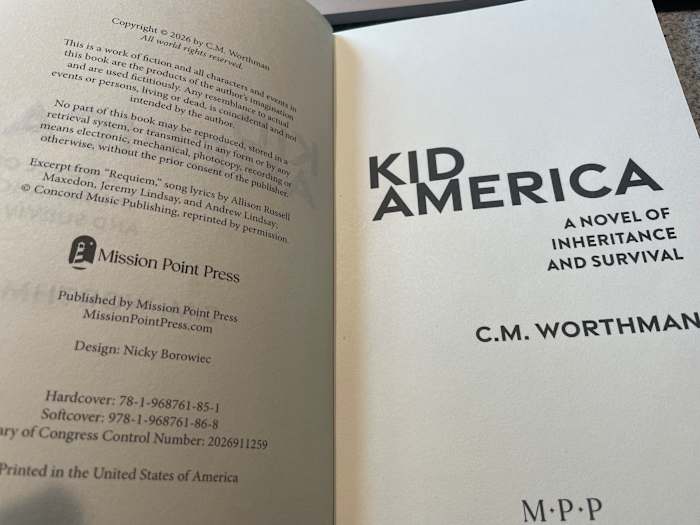
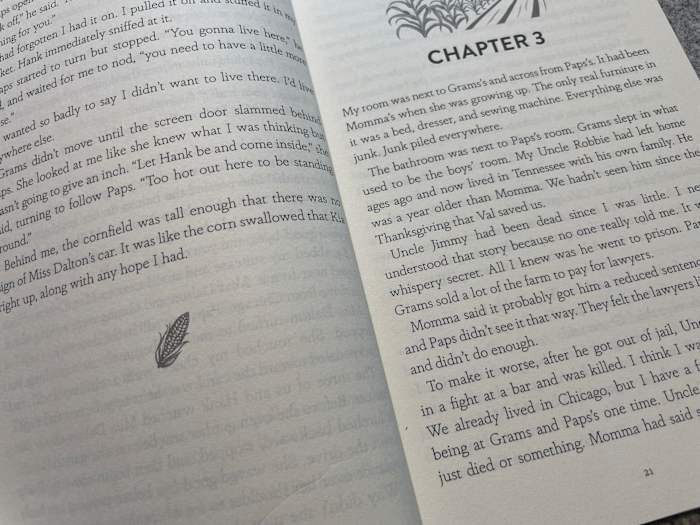
Here’s a few interior shots from the galley proofs:
It's now time to market it.
I know it seems odd there are still four months until the release date (I mean, the novel is ready to go.), but those months are important. Presale begins in a month--July 30 (mark that in your calendar). You, my friend, can pre-order the novel then—you’ll own one of the first copies. It will be shipped to you on November 3. I want to sell as many books as I can by then.
Why? Why the four months and why pre-order?
Here, according to Laura Davis, is why:
· “Publishers base their print runs (and hence their commitment to the book and its marketing) on presales and other indicators of early interest.
· The number of presales indicate the buzz a book is generating ahead of its release.
· If a book racks up substantial presales, reviewers are more likely to review it.
· Librarians are more likely to order it.
· Book clubs perk up and take notice.
· The more presales a book gets, the more copies bookstores order to stock on their shelves.
· All pre-orders “count” as first week sales, giving books their best chance to hit a bestseller list.
· And finally, people who receive the book first (shipped so it arrives the day it goes on sale) can share their excitement about receiving it on social media, then read it and review it soon after its release date, generating more buzz and word of mouth.”
Enough said. You’ll be hearing more as we get closer to July 30 and all the way up to November 3.
For me, everything is now about marketing. First up, in the next few weeks, is working with Terese, my marketing guru at Mission Point Press, on a press release and marketing materials.
I’m putting together a list of independent bookstores, notably those catering to young adult literature. I’ll be contacting them in hopes of setting up author events. I’m also culling a list of teachers and English department chairpersons to contact—those people making English language arts curriculum decisions—with hopes of getting KA into schools. I’m working on curriculum and author visit materials—all fun stuff.
SO IF YOU KNOW OF A BOOKSTORE OR A TEACHER I SHOULD CONTACT, MESSAGE ME.
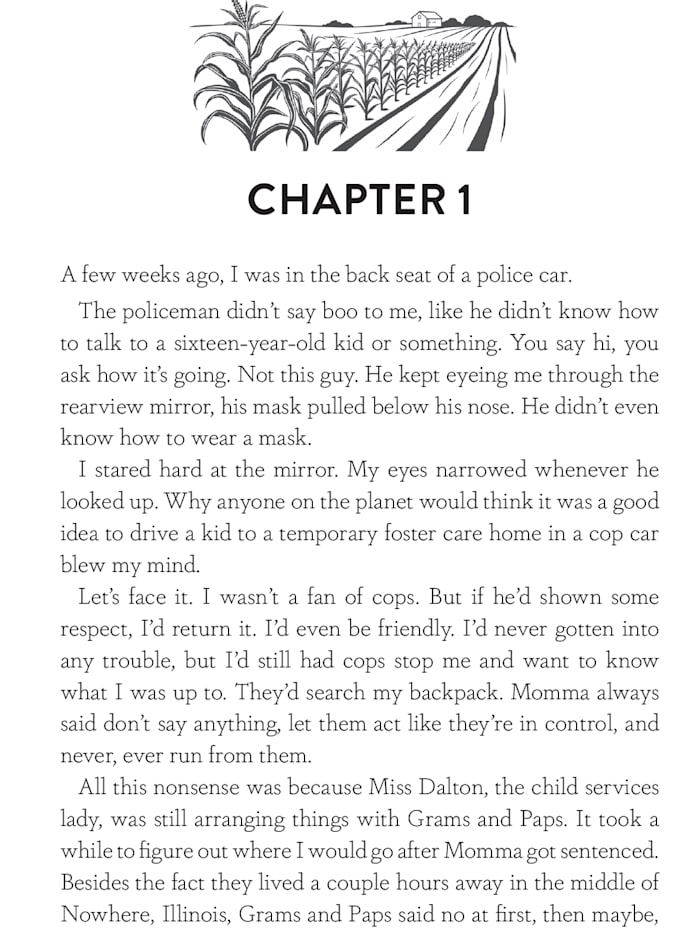
In the meantime, I'll give you a head start on the reading:
I’m only a few weeks away from a major transition in the Kid America production schedule. Revisions, copyedits, cover and back design, acknowledgments, blurbs, and copyright approvals are done. Next up, an actual hardcover (maybe softcover) version is coming to me for review. Yes, the galley proofs have been ordered. With that, and any last-minute copyedits, the novel will be locked down three weeks from today. Done deal.
At that point, marketing officially begins, four months prior to release date. For me, this is a major transition, away from something with which I’m familiar and consider myself good at—writing, revising, and editing—to something completely new—marketing.
I’m gearing up for it, collecting lists of indie bookstores to contact, with hopes of doing book signings and readings throughout fall and winter. I’m also identifying teachers, curriculum coordinators, and English Department chairs to contact, with the hope of having KA integrated into school’s curricula and reading lists in the Chicagoland area. I have a lot of former students out there teaching, so I have that going for me. If all goes well, I’ll expand my efforts to downstate Illinois and into other states.
Reaching out to schools brings me to a new KA project: developing curriculum to go with the novel. I’m writing curriculum for KA, aligned with Illinois curriculum standards. This as part of marketing, and it's within my wheelhouse, as I have over thirty-five years of curriculum development experience. I plan to share some of my ideas in upcoming posts.
I’ll be meeting Mission Point Press’s marketing people within the next couple of weeks. They’ll create the visuals for marketing, e.g., flyers, social media designs, etc. They’ll also get the novel on distribution lists, solicit reviews, and identify contests to enter, among a few other things.
Getting out there and talking to people about the novel will be my job, though. I’m ready.
I haven’t felt this excited about a professional transition since I moved from being an editor (way back in the early 90s) to being a teacher and from being a teacher to being a professor and researcher. I’ve always been strategic about these types of changes, planning way ahead, sometimes years ahead, but committed to what it takes to get it done. There's always a learning curve, and a learning curve taken too fast will leave you wrecked somewhere along the way.
So here I am. I’d say I’d hit the midpoint of the curve, looking around the corner at something new, something I couldn’t have seen or imagined before, but something for which I’ve been preparing for a long time.
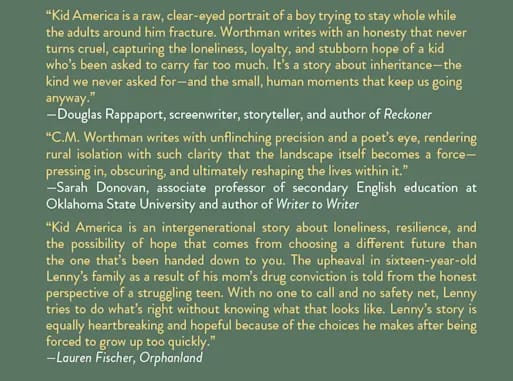
Below is a photo of the blurbs we settled on for the back cover of KA. Thanks to Douglas Rappaport, Sarah Donovan, and Lauren Fischer. All great writers. And, of course, Sarah is a great teacher education.
Over the next few weeks, I’ll share some of the inside matter of the novel, some excerpts, front matter, and other stuff, all pieces of the whole.
Counting Down the Days (posted May 29, 2026)
Kid America is a month away from lockdown. Come July 3 no more changes can be made to the novel. Know, though, that if everything isn’t done by then, the date can be moved back, which requires moving the pre-sale date (July 30) and, possibly, the release date (November 3) back. I don’t think that will happen. We are on schedule… a little ahead of schedule, in fact. But with things still to do, I get a bit anxious. Not much, just a little bit.
Here’s what the last two weeks have looked like:
First, copy edits came to me. I reviewed them. Not as many as I expected, but some changes that would have been embarrassing if they hadn’t been caught. All minor stuff. There’s one more round of copy editing to go.
All told, over the past few years, KA has been read in one form or another by ten or eleven people, usually multiple times, for the purpose of providing feedback, recommending revisions, and editing and copy-editing. Nothing I wrote academically ever got this level of review, except maybe my dissertation, which ultimately made it into book-form with Teachers College Press. The bulk of that review, however, took place during the drafting process and was done by fellow doctoral students and dissertation committee members. It was a different type of review.
Second, a mock-up of the front and back covers came to me. I reviewed and made a couple revisions. It’s back with Aimé and Becky, KA’s production manager and designer, respectively. It will most likely go through a couple more edits.
I also got back the epigraph page and credits page and sent them off to Allison Russell’s people for review. Between all this getting and sending—all via email—there is a lot of ether time, time waiting for others to do what they need to do. It’s not that others aren’t doing what they’re supposed to do—they are. What they’re doing for KA is only part of what they do. They have multiple projects going on, and they know the deadlines. If we’re ahead of schedule it is because of them. So I try to be patient.
I am patient. Mission Point Press set the lockdown, presale, and release dates knowing the time needed to get things done. It’s only with a hiccup or glitch that the timeline gets thrown off, and that hasn’t happened…except for a small hiccup.
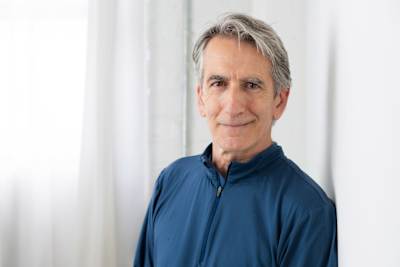
Here’s the hiccup: The photo Anke, my friend, took turned out not to be of a high enough quality, which was a bummer because I liked it of all the photos I have seen of me the past five to ten years. Kudos to Anke. So much for iPhones taking book-quality photos.
So three weeks later and about five or six photos tried out and rejected, I bit the bullet and contacted a photographer—Amy at Amy Bissonette Photography. Yes, I had a photo shoot, for ninety minutes. I can’t recall the last time a photographer took solo shots of me. Maybe in high school for my class photo? After sixty shots, Amy and I narrowed the possibilities to about twenty, then to seven and finally two. I got two high-resolution photos, and the hiccup didn’t delay production.
I’m going with this one:
I still like Anke’s photo and will put it on my website.
With summer almost here, I’ll have more time to try my patience as KA’s production winds down and marketing gears up. I also can turn to the next novel: Helena and the Garbage Dwellers. More to come on that.
Head Rushes and Headshots (Posted May 15, 2026)
The best Kid America news so far in May is the permission to use Allison Russell lyrics in the epigraph. I floated on that news for a couple of days. A great head rush, of the secondary meaning type. And I can thank AI for an assist in making this happen.
After googling how to request permission to use copyrighted materials, I crafted an email with all the pertinent information. I then googled who to contact to ask for permission to reprint “Requiem” lyrics. AI came back with a few people, each with their own expertise in the Russell world, such as who to contact if you want to schedule a Russell performance (maybe one day), who to contact for permissions, and so on.
I googled the permission person to make sure AI wasn’t spazzing me, but yes, the person represented Russell on copyright issues. What would I have done without the internet, Google, and AI? Am that dependent on technology?
Well sort of. I managed well before it existed and manage well without it in all major functions of life. But it sure makes things a lot easier, especially on search and seizure tasks—you know, when you need to find information quickly and grab it for larger purposes.
AI has been a major topic of discussion in my English methods course. To a person, the students have a great disdain for AI. These are twenty-year-olds, too, but they’re becoming English teachers so that serves to counter Gen Z traits. For them, it’s not the cheating, environmental desecration, or bias issues that piss them off, although they recognize those issues as real. It’s the idea that people are cheating themselves of important skill-development opportunities. Put it into the context of teaching, these students are adamant that any use of AI is going to deny their students opportunities to develop critical thinking and writing skills. I agree, but it's nice to be able to ask a question like, “Who’s Allison Russell’s copyright person?” and get an instant response.
Once I got a name and email, I did the rest—I wrote the email, followed up, answered their questions, and so on because I have the skills needed. But my students are right about the cheating-ourselves-with-AI concern (The world would be a much better place if English teachers were in charge.). Now they’re trying to figure out how to be the teacher who can make content relevant and meaningful, so their students won’t want to cheat themselves.
Anyway, I emailed the permission person. Six weeks passed. She finally responded saying she was sending my request to another person. That person, in turn, responded within a few days, with a few questions. I answered them and within two days I had permission to use the lyrics gratis as long as the novel is in print. Easy peasy.
Getting permission to use Russell’s lyrics was easier than getting a decent headshot for the novel jacket. I have only a few photos of me by myself—maybe five or six from the past thirteen years, which is how far back the photos on my phone go. Of course, any photo older than eight years is a deception. I’ve aged, considerable, since my daughter was born. Go figure. I needed a recent photo of only me that was worthy of Kid America.
I went to work. First, I cropped others out of recent photos. That diminished the quality of the photos although it usually made me look better. I’m much more attractive blurred. These photos were “unusable,” so said the publisher.
I took a few selfies, and like all my selfies, they looked like perp shots. I looked like any communities worst nightmare.
I asked John, my neighbor, an avid bird watcher, to take one with his birding camera. He had sold the camera when he stopped birding but offered to take one with his phone, a much better one than I had. The photo looked great. I looked horrible.
That’s when I asked, Bernd and Anke, friends with whom we go camping. We were meeting up at a state park for the weekend. I figured headshots with trees and water in the background might divert people’s attention from me. Anke took about thirty photos, and I sent the two best ones off to the publisher on Monday. Here they are:


Hopefully, one or both these will work. Of course, Beth, the layout designer, will crop and clean them up to make me look pretty (I hope). Thanks, Bernd Ruschmeyer and Anke Drexler. If it’s a go, Anke has a photo credit coming to her.
We are six weeks away from KA’s lockdown date. Everything must be done and no additional changes can be made after that date if we are to meet the July 30 presale date and November 3 release date.
I wrote the acknowledgements. It’s nice to be able to thank those who have played a part in this. Of course, there will be names missing. I set up Ingramspark and KDP accounts. I also created an Instagram account and have begun to post a few things about KA and some links to my website. More on these later.
I’m looking forward to reading copy-edits soon. It will be my first look at the entire layout, book-like. Exciting stuff.
A Novel of Inheritance and Survival (posted April 17, 2026)
With this post, it’s safe to say all revisions have been made to Kid America, including identifying a subtitle. Or at least all major revisions have been made, including a slight but significant one to the title. It is now Kid America: A Novel of Inheritance and Survival. The MPP production team had been pushing for a subtitle from the beginning. The worry was Kid America suggests something fantastical or of the superhero genre. Far from it. The novel is about inheritance and survival.
I started playing with a few subtitles a couple of weeks ago and shared them with friends. The MPP production team gave me about fifteen other possibilities. Aimé, KA’s production director, and I went back and forth on a few of them before I picked A Novel of Inheritance and Survival, based on her strong recommendation and feedback from others.
We’re in the design phase now, working on all the book stuff that goes around the story, like the cover, inside layout, front and back matter. The next time I see the full manuscript will be in layout form and ready for proofing.
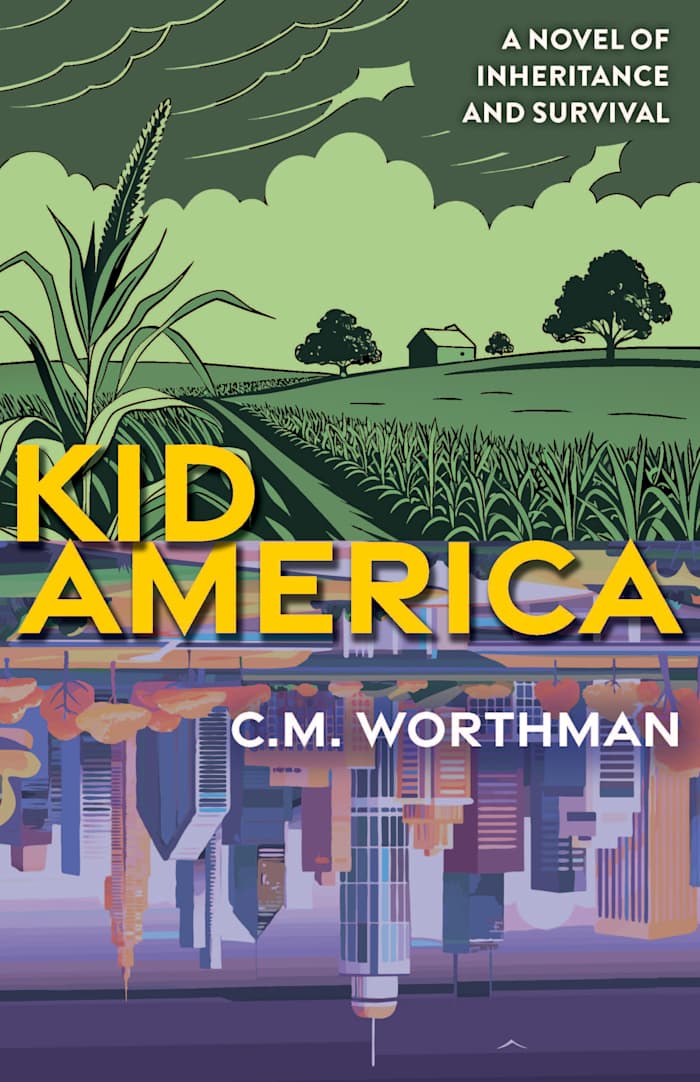
Aimé, Nicky—KA’s graphic designer—and I have been working on the cover for a few weeks, with Nicky doing most of the work, of course. We whittled it down from a half dozen possibilities to one. Nicky is tweaking the color scheme, but it’s all but done and at the top of this page.
I like the contrast of rural-scape and urban-scape and the distinctive appearance of both. The yellow title stands out. My hope is that the cover and title will be hard to miss on a bookstore shelf.
Testimonials are starting to come in. I had written in an earlier update that I would share them, so here are the first two. This one’s from Sarah Donovan:
Sarah’s a literacy scholar and author of Writer to Writer! She sent two lovely extended testimonials, one of which can be read as a book review. I think, like with everything Sarah does, she went above and beyond. She’s a teacher educator at Oklahoma State University in Stillwater, doing great work with in-service and pre-service teachers. Take a look at her Ethical ELA website.
I love Sarah’s line about the landscape being a force itself. A writer will create an image, a setting, an interaction, or whatever and its meaning will rooted in the writer’s subconscious, not fully articulated or developed. For the writer, it just feels right. It often takes someone else to identify more fully what is conveyed emotionally or psychologically. Sarah did that with the line about the landscape.
Here’s another testimonial, this one from author Douglas Rappaport:
Douglas’s most recent book is Dead People. However, it is his Reckonerthat is akin to Kid America in its take on too many adolescents’ lives. More on Reckoner later, as I’m working on a review.
I hope to have more testimonials to share next time. I know at least a couple of other people who have said one is coming.
I’ll be meeting with Aimé next Thursday to review progress and what’s ahead. I need to make some marketing decisions.
On another front, Deborah Halverson sent me feedback and revision recommendations for a middle grade manuscript I’ve been working on for four years. I mentioned Deborah in my first “Road to Print” post. She my editor extraordinaire. There’s lots of work to do on the middle grade novel. It’s my summer project and the follow-up, although not sequel to Kid America, with a goal of publishing sometime in 2027. Meanwhile, Kid America: A Novel of Inheritance and Survival is front and center in my mind.
It's Happening...Fast (posted April 3, 2026)
It’s been a few weeks since I provided an update on Kid America’s road to print. I expected March to be quiet. Kid America was with Beth, the novel’s copy editor. Nicky, the graphic designer was doing mock-ups of cover art and inside layout. My task was to identify and contact influencers. Decisions and edits would happen in April. That’s what I thought.
It turns out things got busier sooner than expected.
In my last “Road to Print” post, I wrote about needing to identify influencers. I had no idea how to contact them and why anyone would agree to say anything about KA without having read it. Aimé, my Production Director, set me straight. Send them the latest draft of the book, she said.
Yep, I was overthinking that one, although nothing I read online said I could send the entire manuscript to someone. It seems intuitive now. Give them the manuscript, of course. Intuition, though, is the ability to use prior experience to make sense of new experience without having consciously to reason about what needs to be done. Sometimes a little direct instruction helps, a little push in the right direction.
I sent KA to people I respect in the young adult literature world, beginning with those who advocate for literature about rural lives and culture. I also sent it to a few authors who have written about rural youth. Over the next few weeks, I’ll let you know where I stand on testimonials, including who has responded. I’ll share the work of the people who are supporting my work. Just know I’m ecstatic with the responses I’ve gotten so far.
To those influencers who don’t respond or who say no, I get it. They shall remain anonymous, and I’ll keep following them and reading their work.
Last week, I got copy edits back from Beth. It came a week or so ahead of schedule. This was KA’s second professional copy edit, the first coming from Deborah Halverson. Before sending the manuscript to Mission Point, I had Deborah do a substantive edit and a copy edit.
Along with her edits and proof marks, Beth identified a couple of other issues she thought needed to be addressed. Like with most feedback, my gut reaction was first to ignore (for a couple of hours), then reject (for about fifteen minutes and as surly as I could get), and then to squirm (for a day or two), because what if they’re on to something and it’s an irreparable flaw of the narrative that can’t be fixed? Usually, they are on to something, and I can fix it.
First, Beth raised a question about the appropriateness of scenes with Lenny, the protagonist, cleaning his grandparents’ nude bodies. Without giving away too much here, I understood Beth’s concern but felt strongly about the importance of the scenes for what they convey about Lenny and his predicament. I realized she had hit on something no one else had noticed, and I needed to address her concern. I revised to show more explicitly how Lenny feels and what he is trying to do and why.
Similarly, the second issue had to do with a scene near the end and the lack of Lenny’s emotional response. The recommendation here was to show Lenny’s emotions (of course), and I revised to do that.
So while I disagreed with Beth’s recommendation to delete the scenes with nudity, I understood she saw something other readers might see and perceive negatively. I think my revisions strengthened the novel by revealing Lenny’s evolution in the face of the conflicts he is facing.
Kid America has gone through so many revisions based on others’ feedback over the last two years or so that it has reached a point where, although every word in the novel was put there by me, the current novel wouldn’t exists without the feedback I’ve gotten. Not everything readers have offered up has been incorporated, but everything has informed my creative process and how the novel comes across to others. Writing is very much a social process or should be to work well.
Ironically, an adolescent, or the audience to whom the novel is aimed, has yet to read KA. I’d like to change that over the next few weeks. I need to find some adolescent readers. Some adolescent influencers.
A final note, with more to come in later weeks: Book cover mock-ups came a couple of days ago. I’m reviewing six mix-and-match cover options and three interior designs, including chapter head art and fonts. Nicky created some beautiful cover designs, giving me options while responding to my preferences to a T. I met yesterday with Terese, a marketing and publicity person, to talk about how to get the book out to the world. Here, too, I have a lot of options I need to wade through over the next couple of weeks.
Whereas all aspects of the publishing process are familiar to me, marketing (including gathering testimonials) is new and something I probably would have refused to do ten years ago. I’ve always believed—and have reminded myself constantly—that I’m the type of person who couldn’t sell lemonade on the sun. I want to do it now,… not sell lemonade but push in any way I can Kid America to the larger world, especially adolescents. How to do that is still to come.
One last thing: Pre-sales begin July 30. Kid America’s release date is November 3.
And We're Off (posted March 6, 2026)
Soon after I posted last week’s “Road to Print” post (see below), Kid America’s publication process kicked in. The work began. I got a Project Manager and a list of things to do. I knew this was coming. I know, though, once the initial tasks are completed, the work will slow, as the novel will be moving through Mission Point Press's queue along with several other books on similar deadlines. My work will come in spurts.
Aimé, my Project Director, sent a questionnaire requesting some of the more difficult texts a writer must create, or at least they are for this writer: a short book description, a long book description, and an author bio. A book description of any length is hard to conceptualize after living through the drafting of the actual book for a couple of years. Of course, I know what Kid America is about, but whittling it down to between twenty-five (short bio) and two-hundred fifty (long bio) words is not easy. It’s akin to describing the child you love in a sentence or two. Sure you can do, but seriously do you want to have to do it?
I also had to identify seven keywords and as many influencers as possible. The keywords part is familiar to me, the influencer part not so much. Of course, I know what an influencer is in the digital media sense, but in book publishing I wasn’t so sure.
IngramSpark describes influencers as people with a following, or people who can reach many other people, preferably readers. Yep, same, same: they're people with social media reach. So I went to the one place where followers are counted and reported—the Internet. Here’s where the keywords came in handy. I used them to search for people who have used similar keywords or who have an interest in the keyword topics my novel addresses. I did a few Google searches and came up with a quick list of bloggers and authors with websites who might be interested in a novel like Kid America. I’m now crafting emails to send to the influencers, fully prepared for rejection.
The whole process seems ass backwards. I’m asking influencers to say something nice about the novel before they can read it. I can send them a synopsis and maybe even a chapter or two, but that’s about it. I’m not sure how they can say anything honest about the novel other than it’s coming out and might be good…or might not. For me, that’s a tough sell not because I can’t convey what my novel is about but because the influencers would be going out on a limb to say something, good or bad, about a novel they haven’t read. Or at least it appears that way to me. It's not something I would do, but I’m not an influencer. But maybe taking that risk is what makes an influencer an influencer?
Or maybe I’m just misunderstanding how this process works? It reminds me, however, of querying agents. That process, too, seemed asinine to me when I was doing it. I had no success at it, and I wouldn’t be surprised if contacting influencers has the same results. But I’ll do it.
I also need to provide Aimé a quality headshot. I found two, quality of both debatable. I’m waiting to hear back from her on whether they suffice.
On Monday, Aimé and I will meet for the first time, virtually. We’ll create a timeline, talk production, and share ideas for the work ahead. Mainly, I'll listen. After that, within the next few weeks, I’ll talk with marketing people. It’s marketing I’m anxious about…but excited to do. I’ll have to put myself out there in ways I have never done before.
I’ve learned a couple of things the past two weeks. One, my life has gotten busier fast, but in a good way. I realize if this is what I want to do everything else I do professionally will need to take a backseat to writing and publishing. Before this, writing co-existed with my other professional responsibilities. I had time for both. That is ending.
Second, I realize that with some initial, albeit small, success I am even more desirous of success. It is not unlike what I felt when I began doing scholarly research thirty years ago. When people noticed, I took heed and tried even harder. For me, success, no matter how small, begets the desire to work harder if only to legitimize the success.
I have another novel working its way through a professional edit. I want the second one ready for publication before Kid America is released. The second would come out in early 2028. After that, there is a third and a fourth novel in my queue, fully drafted. Looking way ahead, I plan to publish them all, each about a year apart. Knowing the publishing process and the need to market what I put out there, I hope in a year or two I can fully transition to being a writer and not a writer and professor. I’ve said this before, but this time it’s not so much an aspiration. It will be a necessity.
I Just Wanted to Write 50,000 Words Fast (posted February 27, 2026)
I started writing Kid America on November 1, 2021. I signed up for NaNoWriMo, the National Novel Writing Month challenge, with the goal of writing fifty thousand words for the month. The challenge was an annual thing. It was the first and only time I did it. The sponsoring organization went under a couple of years later, its demise shrouded in scandal. No, it had nothing to do with me. And fear not, there are alternatives for those looking for a writing kick-start.
When I started Kid America, I already had solid drafts of two middle grade novels that weren’t going anywhere. I hadn’t given up on the MGs, but I was ready to tackle something aimed at older readers and timelier. Covid was on its last leg, and I was anticipating an onslaught of pandemic novels. Why not, I thought.
I wrote over fifty thousand words that November, a good chunk of it in California during Thanksgiving week. Then I let the novel sit…for a couple years. I started and nearly finished a third middle grades novel and revised the first two. I didn’t open the Kid America file during the time.
When I did open it, Covid had passed, but the narrative still resonated with me. It read, however, like a hodge-podge of memories and incidents that, while connected by time, place, characters, and conflict, didn’t hold together as a novel. Which made sense in retrospect. As I wrote each day in November 2021, I never went back to reread what I had written the day before. Each day, I picked up where I thought I had left off the day before. Also, I didn’t have an ending. Or maybe on November 30, 2021, getting to 50,000 words was my ending? In reality, though, I had 53,437 words.
I began reworking, starting on page one, and revising, rewriting, and in several places creating anew. As I rewrote, I was more conscious about the whole and what each beat was contributing to it. I tracked character development and narrative ark. I fleshed out backstories and settings. In some places, I was not so much drawing on childhood experiences as I was drawing on my impressions of those experiences. I wasn’t drawing on memories but on the meaning of those memories. I gave them to Lenny, the main character.
I also drew on what I knew about rural life and the quiet stoicism of farmers and blue collar workers. I could not have named all this as a child, but as a writer, the lives of farmers and factory workers were intuitive to me. I had lived it, not directly but as a child observer of adults. I felt I knew who my characters were in real life, whether it was Mom, Paps, Grams, Yellow-Hair, Misty, and all the rest.
I used my memories of schooling to create Lenny’s school experience. That I had lived. I imbued in the kids and teachers some of what I remembered about my education. I also drew on students I had taught in Chicago schools and community sites. I was writing about two very different contexts—urban and rural—but I had lived a long time in both and knew both from a working class perspective.
By Fall 2025, I had the novel I wanted, clocking in at just over 43,000 words. I did some research and found a couple of editors. Having emailed with both, I picked one: Deborah Halverson. She first did a substantive edit, identifying strengths and shortcoming and offering recommendations (most of which I took). I spent a couple months revising. Then Deborah did a line edit to make it look pretty. I edited accordingly and did a bit more revising, again taking what Deborah offered to heart.
I had never enlisted a professional editor before. Friends and family have read my stuff. I’ve participated in writing groups. All offered good feedback, but none the depth of review Deborah offered. I had what I saw as a submittable draft by the end of January 2026.
So I submitted to two hybrid publishers. With a history of rejection after rejection on my first two middle grades novel, I wasn’t interested in going through the slow slog of querying agents or contacting publishers and hearing back from less than five percent of them. “Nice, but no thanks,” had become grating.
With the hybrids, I heard back within a couple of weeks. We talked, they sent proposals, and I decided Mission Point Press was the one for me. It had good reviews. An internet search found nothing suspect about them. They ticked all the boxes people in the know about hybrid publishers said they needed to tick. And Jen Wahi, the President and CEO, was direct, informative, and easy to talk to. No sales pitch, just a detailed description of what they do and what will happen if I go with them.
I signed the proposal and am on my way. I’m awaiting a timeline but have a tentative pre-release date in September, and a release date in late November 2026, or early January 2027. I’m putting together an author bio, trying to find a pretty photo of me (good luck, right!), and thinking about cover design. Ahead of me is reading copy-edits and proofs, reviewing designs, and doing something I’ve never done before, marketing my book, or marketing anything for that matter.
With my first book, an educational ethnography, I made no effort to sell it. Although I wanted people to read it, I had no inkling or desire to market it. It’s now out of print. This time around, I’m ready to do what I need to do to get it out there and in people’s hands or on their devices. So here goes.
Over the next several months, I will provide updates from time to time on what is happening. It’s a new journey for me, one I’m happy to share.