Who and what's to blame
I'm going off the rails on a crazy train
I'm going off the rails on a crazy train
--Ozzie Osbourne (1980)
We left the basketball game early to be beat the crowd to McDonald’s. Phil, my best friend since fourth grade, said we could cut through the park and across the railroad trestle. It would get us to the restaurant before the others, possibly even before the game ended and everyone in the gym headed for fast-food row.
The first weekends of February in Indiana were warmups for the multi-week state high school basketball tournament. Junior varsity and freshman teams played Saturday tournaments until the varsity sectionals started the third week of the month. Four schools would meet in a high school gym for two morning games and two afternoon games. The team winning two games was champion for the day.
I was a bench player for our Freshman team, and by that I mean I wasn’t so much a reserve player as a player who never left the bench. I hadn’t played in five games. I probably averaged about fifteen seconds of playing per game. I wasn’t going to play in the tournament.
Phil, on the other hand, was the first player off the bench. In the first game of the tournament he played ten minutes and scored six points, helping to catapult us to the afternoon championship.
As we sat watching the second morning game, I suggested we leave before it was over and go for lunch. Each of us was given three bucks and expected to find our own lunches between games. If we left now, we would have at least three hours before our next game. That’s when Phil suggested we cut through the park instead of staying on the roads.
We walked across the high school’s athletic fields and through the city park next to the school. It was a shortcut of a couple hundred yards and about ten minutes. The only obstacle was a railroad trestle across a river. Once over it, we would be behind the mall and next to McDonald’s.
Phil noticed the train on the trestle as we crossed the park. “We should turn around,” he said.
“No way,” I said. We were too close to the mall to turn around and, besides, I was an experienced railroad hiker, having walked the tracks between the two small towns I lived near many times, including crossing the trestle over the reservoir in one of the towns. “We can still get across,” I said. “I know how.” How, though, I wasn’t sure. I had never crossed a trestle with a train stopped on it.
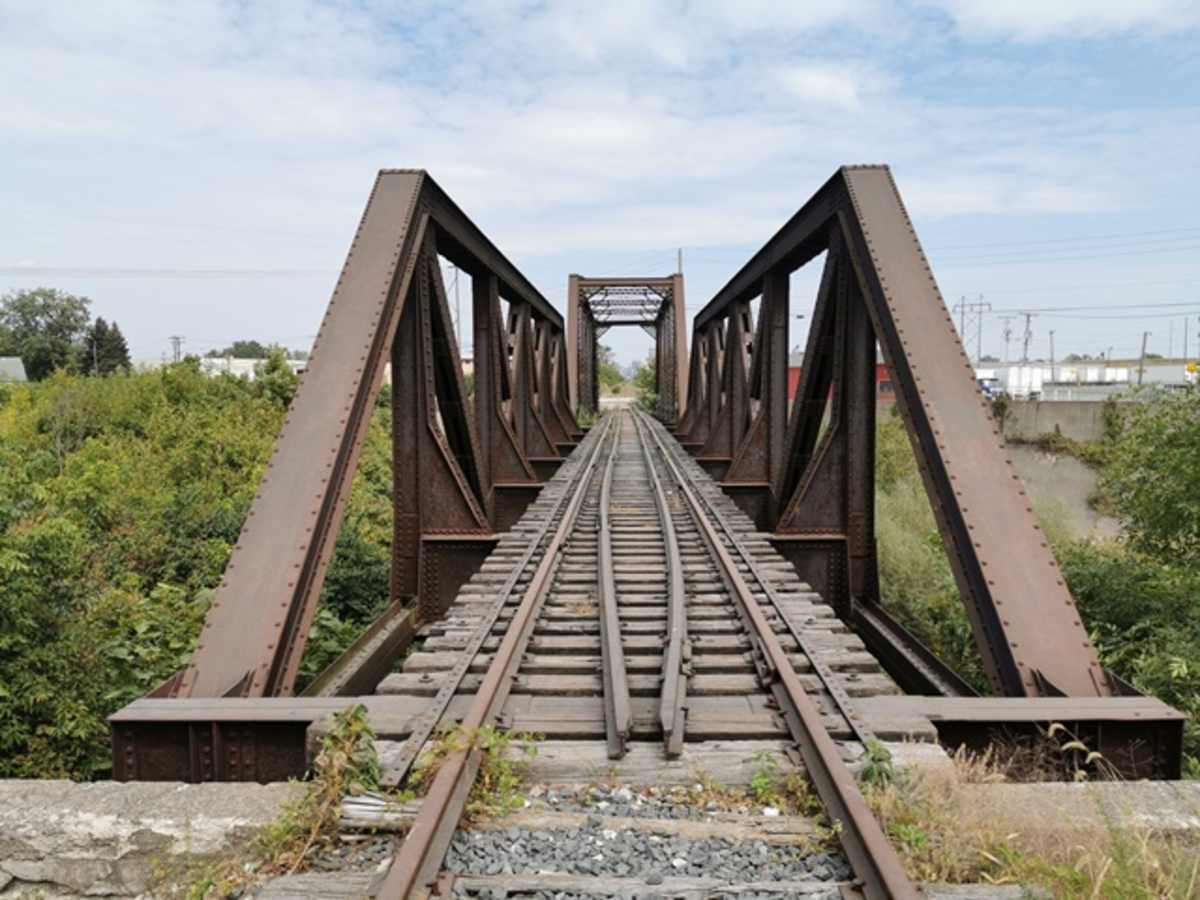
The engine of the train was on the other side of the bridge. The cars stretched across the bridge and out of sight beyond the park and school grounds. The trestle deck was encased in steel parapets, with the railroad ties atop the deck’s steel crossbeams. The parapets rose six feet above the deck on each side and dropped four feet below, literally encasing the train of both sides as it went over the river.
“Someone’s coming,” Phil said, breaking my focus on how figuring out how we’d get across the trestle. He nodded toward two people cutting across the park from another direction. As they got closer, we saw they were girls about our age. They were staring at the trestle with the same expressions as ours. We came together at the bridge
“How are we going to cross that?” one of the girls said to the other. “Are you crossing the bridge?” she asked us.
“We’re going to McDonald’s,” Phil and I said.
“How?” the other girl asked.
I stepped up, and with my bench warmer’s bluster, said: “We’ll crawl underneath.” I squatted to see if that was even possible. “Yes,” I said, standing. “There’s plenty of room. We can crawl on the ties.”
Phil shook his head. “No way,” he said. “I’m not crawling under a train. If that things start moving—”
“Yeah,” the second girl said. “I’m not either.”
“I’ll crawl, but not underneath,” Phil added. He pointed to the top of the parapet on our side. “We can crawl on that. It’s wide enough.” The top was a flat steel beam about eighteen inches wide.
“I’m not crawling up there,” I said. “You could fall in the river.” I kneeled. “There’s no way you can fall through the ties. There’s like six inches between them.”
“I’ll go underneath, too,” the first girl said.
Phil took a deep breath. “Okay, see you on the other side.”
The first girl and I watched Phil and the second girl shimmy up the parapet. Once they were on top and crawling, we crawled under the train and started across, making sure each hand and knee forward landed in the middle of a tie. This was going to be easy.
We were halfway when we heard the loud clang. It sounded like steel on steel. The noise reverberated through the steel deck and ties. We froze. I glanced back at the girl.
“What was that?” she said.
“Nothing,” I said. We started crawling again. Before going five feet, we felt the car above us shudder, its steel underbelly heaving forward a few inches like something had rammed into its back end.
I turned my upper body toward the girl. “I think the train’s moving,” I said.
She nodded, her eyes scanning the car above us. She looked back to where we had started. “Should we turn around?”
We were in the worst possible spot—the dead center.
“No,” I said. I scanned the parapet on both sides. “Here.” I pointed to where it dropped below the deck. The railroad ties didn’t extend all the way to the wall. There was about a foot and half space between it and the ties. At the bottom of the parapet, there was a steel six-inch ledge. “Down here,” I said, pointing. I climbed over the tracks and began to slide between the ties and parapet. I stretched my legs until my feet were on the ledge and leaned back, balancing myself by grabbing the end of a tie. I was clear of the car, my head level with its bottom. The girl followed. She came down next to me. Our bodies pressed together and against the steel wall behind us, as the car started rolling slowly forward.
We stared at the train. I grabbed the girl’s hand and held it tight. “Stay way back,” I whispered. The train was picking up speed. The engine whistle rang out somewhere up ahead. I hoped Phil and the other girl had made it. As the train picked up speed, the parapets began to vibrate. I hoped if they hadn’t made it they were hanging on tight.
What seemed to have come in an instant now happened in slow motion, as the train rumbled loudly but slowly past.
“What’s your name?” the girl asked.
I told her, and she said her name was Sarah.
She asked if I had been at the basketball game. I said yes. She said she had been there, too, that she and her friend always walked across the trestle. They were freshmen at the school. She asked who I played for.
I laughed and told her Hamilton Heights, but I didn’t play, I said. I sat the bench.
“Yeah,” she said. “Basketball’s pretty lame.”
“Yep,” I said. “I think I’m done with it forever after today.”
She nodded. The last few cars rolled by, and with the caboose, the sky appeared above us. The rumbling receded and all we could hear was our breathing as we climbed back onto the tracks. We stood, in the middle of the trestle. Phil and the other girl stood next to the tracks at the edge of the bridge. The train was out of sight.
The girl with Phil jumped up and down. Phil let out a yelp and pumped his fist in the air. Sarah and I started toward them, walking slowly, staring at the ties below our feet. “That was crazy,” Sarah yelled, as we came to the end. “I think he saved my life,” she added, gesturing toward me and grinning, tears in her eyes. She and her friend hugged.
Phil nodded his headed. “Don’t crawl under trains again,” he said, chortling.
We lost the championship. Phil played nearly half game but didn’t score. I sat on the bench, every once in a while catching Sarah’s attention in the stands on the other side of the court. She would smile and give a half wave. I returned.
I wasn’t sure how much we lost by or who played well or badly. I didn’t care. My basketball career ended that day. In truth, it probably ended weeks before, maybe even years.
It hadn’t always been like that. I had been a starter on my sixth-grade team four years earlier. We won our six-team elementary championship. People thought I was good. I liked the feeling. It was probably what kept me playing until that February Saturday in Tipton.
At the end of the bench as the game ended that day, I had a new reason to feel good about myself.