I’m not an avid fan of William Blake’s poetry. I’ve read it, first as an undergraduate many, many years ago and again as a graduate student many years ago. I probably wouldn’t have read his poems otherwise. There’s something to be said about making people read things they normally wouldn’t. Of course, finding meaning in what we read is both a personal and social act. What Blake means to me has as much to do with who I am and the world in which I live than it does with who Blake was or wrote.
His poetry aside, I am a fan of Blake, having read the Poetry Foundation’s biography and a few other articles about him. I admire his dedication to his art—print and visual—and his unwavering beliefs about people and the world. He toiled in obscurity and lived in poverty but not because of lack of talent or effort. The first line of the Poetry Foundation biography captures who he was and why I love him: “…William Blake worked to bring about a change both in the social order and in the minds of men.” Not a bad thing to be remembered for.
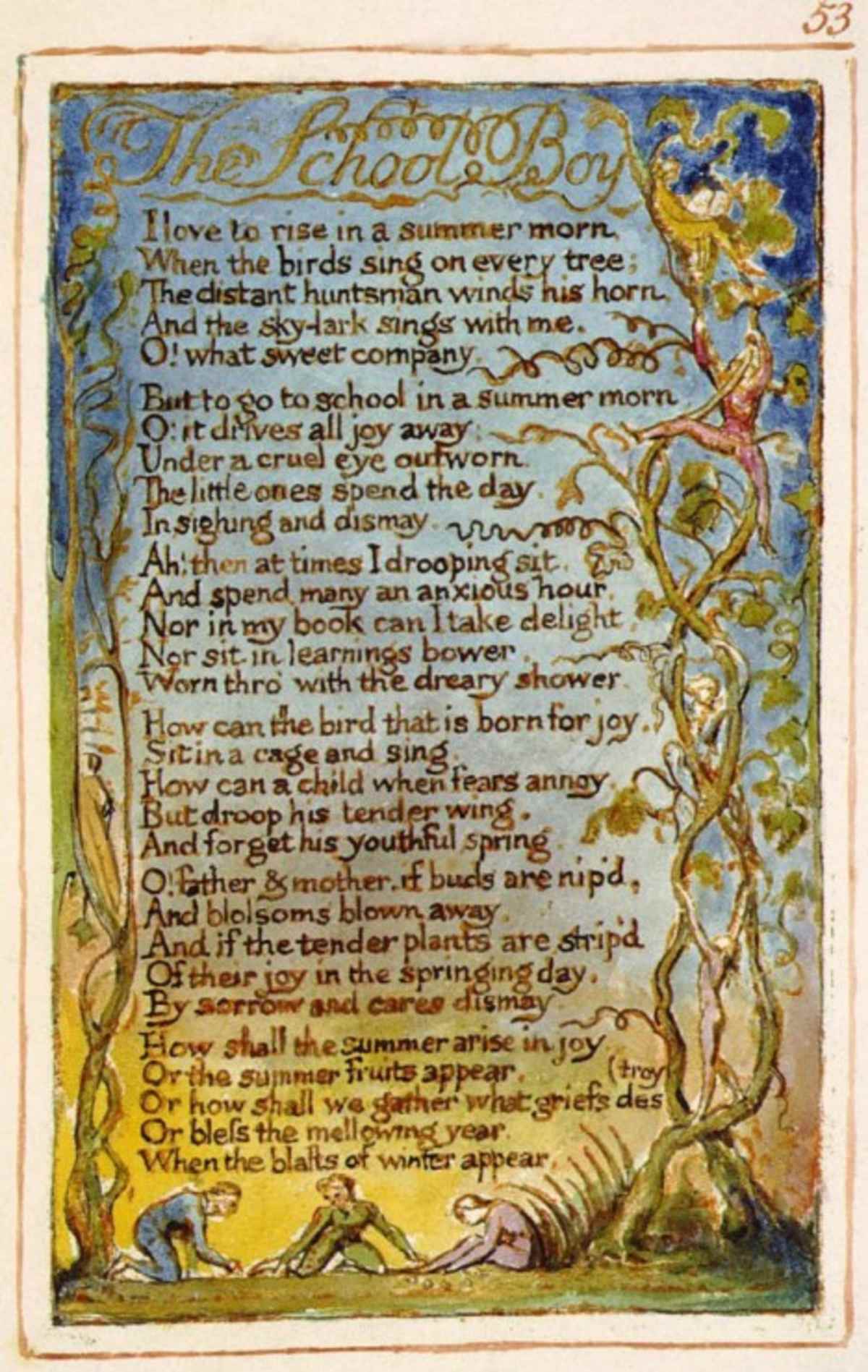
Much of what Blake wrote could be taken by the uninitiated reader as simple verse. Beneath his often moralistic tone, however, is a depth of social critique that cuts to the core of human relationships. Take “The School Boy,” it’s first four stanzas a veritable child’s nursery rhyme. As a pastoral poem about the adverse effects of formal schooling, it rings as true today as it did in its critique of late eighteenth century British education.
The first four verses compare nature with school from a child’s perspective, lamenting summer mornings lost to school. The concrete description of school daze conjures a bittersweet and rhapsodic childhood tarnished by formal education. Blake’s nature imagery of the summer morn, birds song, and a huntsman bugle is juxtaposed with school’s numbing effect. The child is confined to a desk, reading boring stuff, as nature stands ready for him beyond school walls. School leaves the child narrator “sighing and dismay[ed],” yearning to be outdoors.
The child narrator’s voice rings true today in the voices of many youths, although the yearning for nature—to be outdoors—has unfortunately diminished. Blake, though, is critiquing the numbing effect of an education system that hasn’t changed much in over 200 years. If anything it may have gotten worse, as education has become more commodified and standardized in the service of maximum economic production and consumption.
For me, it hits close to home for other reasons, too. My daughter, who as recently as a two years ago loved school, is now bored and dismissive of it. It’s not surprising that her disdain has grown in proportion to the increased paper load (iPad load, too) of busy work and the constant perform on demand ethos that take shape around fifth grade and grow in subsequent years until school is nothing but an exercise in perseverance.
Like Blake’s child narrator, my daughter and many kids, reject what school offers not out of a lack of interest in learning but because of an innate interest in learning. It’s an interest that emanates from effort to define who they are and understand how they fit into the larger world. Too many adults today don’t get it, as they strive to ensure their children have a competitive edge, whether via test prep, college prep, or long nights of homework prep, with an eye on the future but blind to the moment.
Starting in stanza four, Blake goes full-on Romantic (of the British literary type). The relationship between the child narrator and nature shifts from being physical (being or not being in nature) to spiritual (being one with nature) and the ultimate effect of severing that relationship. Just as the caged bird will not sing because of his artificial environment, a child will not grow spiritually or morally cut off from nature. Explicitly directed at parents, these last two stanzas stand as a warning to all us adults.
Children need to be active and experience the world unhindered by others’ directives. It’s not that we shouldn’t want them to learn school content, even in those instances when it may be of little interest to them. It is that we want them to explore content and do something with it, or as the Romantics would hope, to immerse themselves in the natural world. We can expand that to advocate for immersion into the larger world beyond classrooms, and its handouts and textbooks, to the world outside school, to the world they live in, a lá my experience of reading Blake’s poetry.
I may have stretched Blake’s intentions a bit. We are of two different worlds, so naturally we have experienced life differently. I think we have a similar sentiment, however. Ultimately, Blake is saying if the child is confined to the classroom, then what’s the point of education, especially if they don’t want to be there. And what or who is it serving? Not the child. And definitely not the adult the child will become. Obviously, Blake said it better than I can, but I can see it. I see it every day.